Imagine Peter, who runs a bicycle shop in Žilina and an e-shop alongside it. Until now he has paid for ads on Google and Facebook. This year, though, his customers keep telling him that they picked their model based on what ChatGPT recommended.
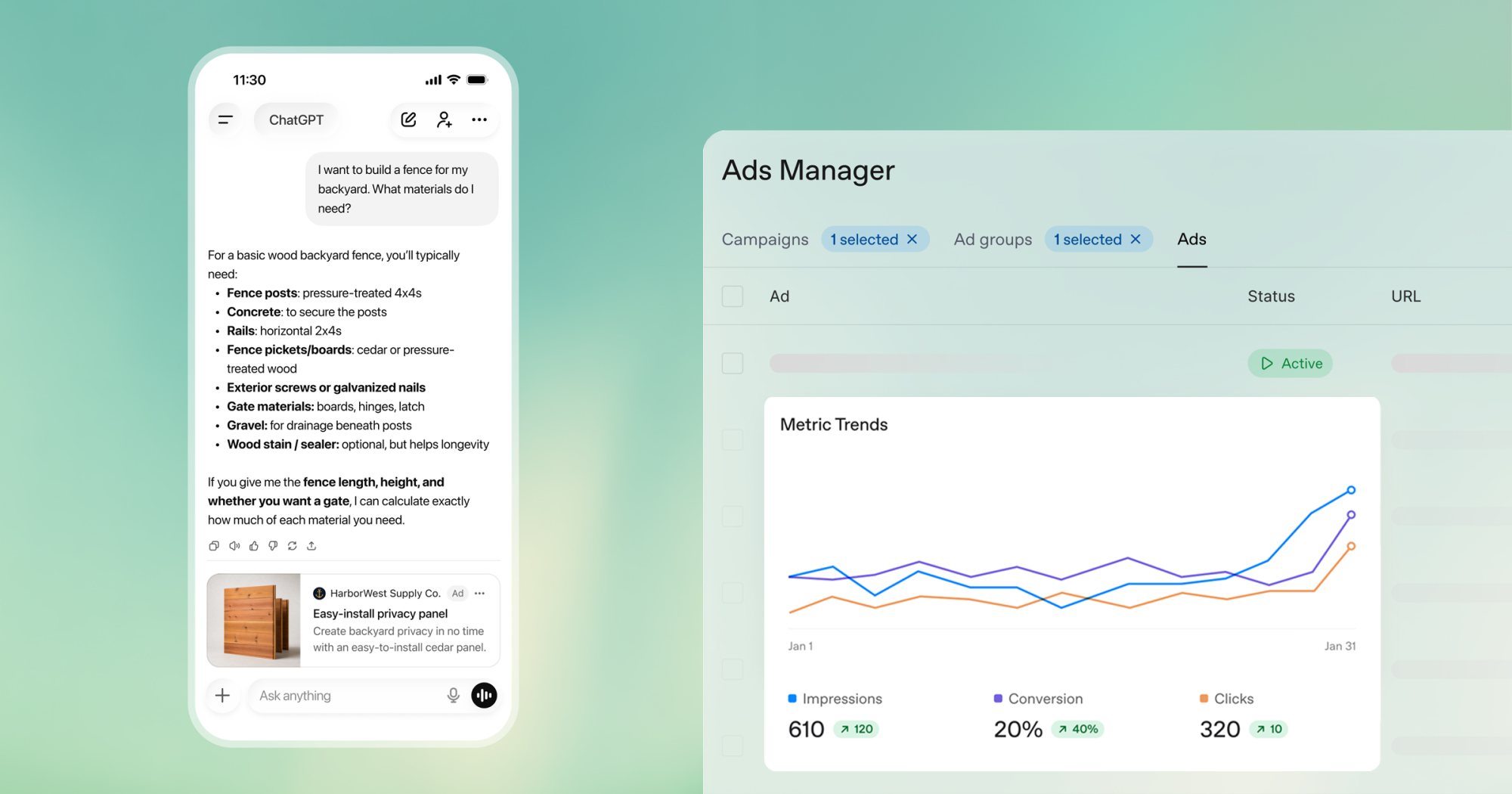
Since paid advertising appeared in ChatGPT, Peter's question sounds different: can you buy a spot there, and is it worth it? A paid ad is a separate block below the answer. It will not increase the chance that ChatGPT recommends you itself, right there in the text of the answer; that is a different discipline.
This information is valid as of 7 September 2026. Advertising in ChatGPT is still in a testing phase and changes literally from week to week.
What happened and why it is an opportunity
OpenAI launched the first live test in February 2026 in the USA, Canada, Australia and New Zealand. In May the United Kingdom, Japan, South Korea, Brazil and Mexico were added.
Since 24 August 2026 the ads have been showing in 31 European countries: across the whole European Union plus Iceland, Norway, Liechtenstein and Switzerland. Slovakia is among them.
Since 31 August the self-service Ads Manager has been open as well, meaning the interface where you set up and launch a campaign directly, without waiting for a salesperson from OpenAI. Slovakia is on the official list of countries where an account can be opened. Even so, it is still a test version and it is open only to companies from approved industries whose ads pass a review. An eligible country is therefore no guarantee of an approved account.
It is a new place to advertise and the competition is not yet queuing up there.
What the ad looks like and how it is selected
The ad appears as a separate block below the end of the answer. It is visually separated, labelled as sponsored and it is not inserted into the text of the answer. It contains your name, your logo, a headline, a short description, an image and a link to your website. There is also a format with several products side by side.
The main difference compared with Google: you are not buying keywords. Instead you write so-called context hints, in other words contextual clues. In your own sentences you describe the situations and topics in which your product makes sense, and the system works out from that which conversations it will let you into. It is not an exact match and it guarantees you nothing.
In Europe only non-personalised ads are running for now. They are selected according to what the person is talking about at that moment, plus basic data such as approximate location and language. Personalisation, meaning ads chosen also according to what you dealt with in ChatGPT earlier, is due to come later and only for those who switch it on themselves.
Who sees the ads
ChatGPT has several plans, meaning subscription price tiers. Only users of the two cheapest ones see advertising: the free Free plan and the paid Go plan. The Plus, Pro, Business, Enterprise and Edu plans stay ad-free.
Nor are they shown to accounts that OpenAI judges to belong to someone younger than 18. Anyone on the Free plan can turn the ads off free of charge in exchange for lower limits and restricted access to some tools.
So your ad will be seen by people who either do not pay for ChatGPT or pay little. How many of them there are in Slovakia, OpenAI does not disclose.
A glossary without the waffle
- CPM – you pay for a thousand impressions regardless of whether anyone clicked.
- CPC – you pay only when someone actually clicks. OpenAI recommends starting with a cap of 3 to 5 dollars per click.
- oCPC – you still pay per click, but the system looks for people who are also more likely to buy from you.
- Second-price auction weighted by relevance – the impression is decided by a bidding process in which it is not only the highest bid that wins, but also how well the ad fits the conversation. The winner pays only as much as is needed to beat the runner-up.
- Conversion – the action you want from a visitor: a purchase, an order, a submitted form.
- Pixel – a piece of code on the website that reports to the advertising system that a visitor really did buy after clicking.
Who it pays off for and who should wait
Now the honest part. Not yet, if you are a doctor, an insurance company or a political party. Ads are not shown alongside conversations about health and politics, and political advertising is banned outright. Companies from healthcare and finance have to go through a stricter approval process.
Not yet either, if you rely on precise targeting. In Europe you can only target a whole country, cities and regions only in the USA, so Peter from Žilina pays for impressions across the whole of Slovakia. Your own customer lists do not work here either, so you cannot exclude your existing clients.
Not yet, if you do not have proper measurement on your website. When you do not know what an order from Google costs you today, you will find out nothing in a new place with nothing to compare against and you will simply be spending.
And one more thing out loud. You will not find out in which conversation your ad appeared. In Google Ads you can look at a list of the actual searches after which the ad was shown; in ChatGPT nothing like that exists.
Yes, if you sell something people take advice on before buying, you have a working website with measurement and a test budget that will not cost you a whole quarter. The lowest daily budget is 15 euros.
In closing
Nobody yet knows the real prices on our market, and OpenAI itself says that benchmark figures do not exist.
The company claims that advertising does not influence ChatGPT's answers and that advertisers cannot get to your conversations. Nobody has verified this from the outside, so take it as a promise, not as a fact.
For an ordinary company this leads to a simple conclusion. It is worth testing with a small budget, but not worth rebuilding your whole marketing for.
If you cannot judge whether it makes sense in your particular case, we will gladly take a look. We do website and campaign audits free of charge and with no strings attached, just get in touch. We will tell you straight whether advertising in ChatGPT can bring you anything today, or whether your money is for now better spent elsewhere.